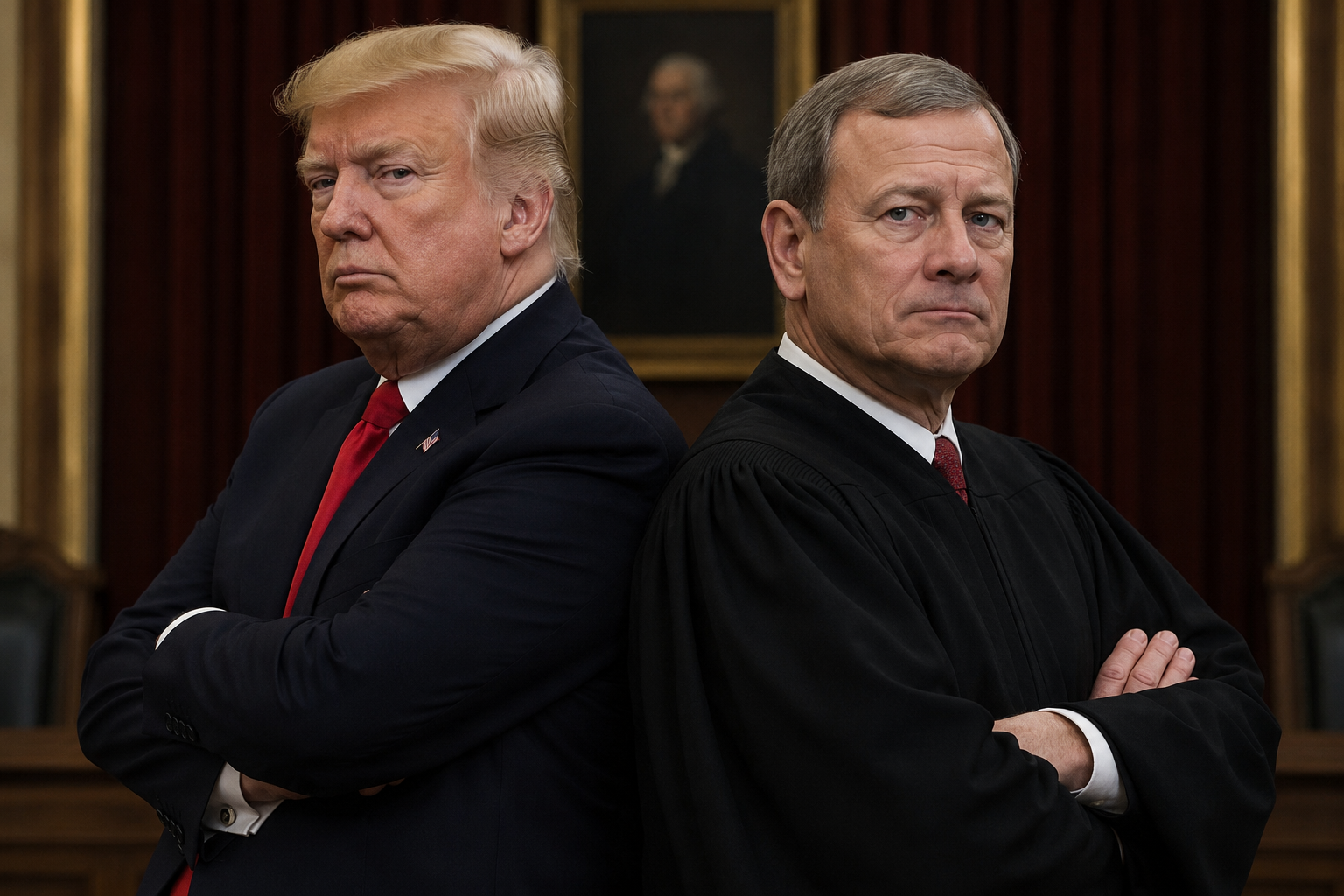
The Media is Reading this Wrong—On Purpose
On July 8, 2026, President Donald Trump posted a demand on Truth Social that the Supreme Court immediately rehear its landmark birthright citizenship decision in Trump v. Barbara. The mainstream press treated it as a tantrum. Legal commentators called it a procedural dead end. AI called it a “dead letter”. Social media shrugged — the Court hasn’t granted a rehearing of an argued case since 1965.
They’re all wrong.
This is not a futile legal gesture from a sore loser. It is a deliberate, methodical opening move in what may become the most consequential confrontation between the executive and judicial branches since Andrew Jackson looked at Chief Justice John Marshall and reportedly said the words that every constitutional scholar knows by heart.
The rehearing will almost certainly be denied. Trump knows that. His legal team knows that. And that is precisely the point. The petition for rehearing is the polite version. It is the formal, procedural, by-the-book request that establishes a clean narrative baseline: We asked them to fix their mistake. We showed them the text. They refused.
What comes after the denial is the part that should keep Chief Justice John Roberts awake at night.
The Worst Decision In Recent Memory
To understand why this confrontation is coming — and why it is constitutionally justified — you have to understand what Roberts actually did in Trump v. Barbara. Not what the headlines say he did. Not the sanitized version from the legal commentariat. What he actually wrote.
On June 30, 2026, the Supreme Court ruled 6-3 to strike down Executive Order 14160, which sought to deny automatic citizenship to children born on U.S. soil to parents who were unlawfully or temporarily present. Chief Justice Roberts authored the majority opinion, joined by Justices Sotomayor, Kagan, Barrett, and Jackson. Justice Kavanaugh concurred in the judgment but dissented in part, and Justices Thomas, Alito, and Gorsuch each filed dissenting opinions.
The surface read is simple: birthright citizenship stands. But the constitutional carnage Roberts inflicted to get there is staggering.
Roberts Didn’t Interpret the 14th Amendment. He Rewrote It.
The Citizenship Clause of the Fourteenth Amendment reads:
“All persons born or naturalized in the United States, and subject to the jurisdiction thereof, are citizens of the United States and of the State wherein they reside.”
Five words in that clause carry enormous constitutional weight: “and subject to the jurisdiction thereof.” Those five words are a qualifier. They are a limiting condition. The framers of the Fourteenth Amendment did not write “all persons born in the United States are citizens.” They wrote “all persons born in the United States AND subject to the jurisdiction thereof.” The word “and” is conjunctive. Both conditions must be met.
Roberts effectively read those five words out of the Constitution. In his telling, “subject to the jurisdiction thereof” simply means anyone “present on U.S. soil and subject to U.S. laws” — which is everyone. Tourists. Temporary visa holders. People who crossed the border illegally yesterday. Under Roberts’ interpretation, the qualifying clause qualifies nothing. It is constitutional decoration. Ornamental text in the most consequential amendment in American history.
That is not textualism. That is not originalism. That is a result in search of a justification.
The Wong Kim Ark Shell Game
Roberts leaned heavily on United States v. Wong Kim Ark (1898) as his controlling precedent. There is just one problem: he fundamentally misstated what that case actually held and what its narrow decision was all about.
Wong Kim Ark was born in San Francisco to parents who were Chinese nationals. His parents had emigrated to the United States and lived lawfully in San Francisco for more than twenty years. They were lawful permanent residents. They had established domicile. They lived under the protection of U.S. law and owed allegiance to the United States by virtue of their permanent, voluntary, lawful presence.
The Supreme Court in 1898 held that Wong Kim Ark was a citizen because his parents were lawful, long-term, domiciled residents of the United States. The Court did not hold that every person who happens to be physically located on U.S. territory at the moment of giving birth automatically confers citizenship on the child regardless of the parents’ legal status, intent, or allegiance. That is a dramatic expansion of the holding — and Roberts made it look like settled law.
When the administration argued that Wong Kim Ark’s holding was narrow — that it applied to children of lawful permanent residents, not to children of transient or unlawful entrants — Roberts dismissed the argument by claiming that the Court’s references to domicile were incidental, not central, to the holding. He wrote that the Court ‘at no point identified any evidence that the ratifiers thought themselves to be imposing a domicile limitation.’
That claim is remarkable in its audacity, no, actually it’s bald-faced lie, because the congressional record of the Fourteenth Amendment’s drafting says the exact opposite — and Roberts knows it says the opposite. Yet Roberts chose to ignore the 14th Amendment’s framers’ own words and explanations.
What the Framers Actually Said—And Roberts Ignored
When Senator Jacob Howard introduced the Citizenship Clause to the Senate in 1866, he explicitly stated that it would exclude ‘persons born in the United States who are foreigners, aliens, who belong to the families of ambassadors or foreign ministers.’ He was not describing a narrow exception for diplomats. He was describing a categorical exclusion of foreign nationals and their children.
Senator Lyman Trumbull, chairman of the Senate Judiciary Committee and a principal architect of the Fourteenth Amendment, defined ‘subject to the jurisdiction thereof’ as meaning ‘not owing allegiance to anybody else.’ Not ‘physically present.’ Not ‘subject to U.S. laws while here.’ Owing complete political allegiance to the United States and no other sovereign.
Under that definition — the definition provided by the men who actually wrote the clause — a child born to a foreign national temporarily or unlawfully present in the United States is not ‘subject to the jurisdiction thereof’ in the constitutional sense, because the parents owe their primary political allegiance to a foreign sovereign. The child’s citizenship follows the parents’ allegiance, not the geographic accident of where the mother happened to be standing when she went into labor.
Roberts did not engage with this legislative history. He did not refute it. He simply bypassed it — and leaped backward across centuries to find a more convenient foundation.
Medieval British Common Law Is Not The Constitution
Here is where Roberts’ opinion crosses from questionable interpretation into intellectual incoherence.
Unable to ground his holding in the actual text and legislative history of the Fourteenth Amendment, Roberts reached back to English common law — specifically, the feudal doctrine of jus soli, the ‘right of the soil.’ Under this medieval concept, anyone born within the physical dominions of the English monarch was automatically a subject of the Crown, because they were born under the sovereign’s protection and owed allegiance in return.
Roberts argued that the framers of the Fourteenth Amendment were drawing on this common law tradition when they wrote the Citizenship Clause. In his telling, ‘subject to the jurisdiction thereof’ was simply a translation of the old English concept of being within the King’s allegiance — a purely territorial, geographic test.
The problem with this argument is so fundamental it is almost embarrassing to have to state it: the United States of America fought a revolution to reject the concept of involuntary subjectship based on geography.
The American Republic was founded on consent of the governed — the social contract theory that citizenship is a mutual political compact, not a feudal obligation imposed by the accident of birthplace. The Declaration of Independence is, at its core, a repudiation of the idea that the King’s territorial sovereignty automatically creates subjects. The entire American experiment is built on the premise that the governed must consent to the government, and that government derives its legitimacy from that consent.
By anchoring his interpretation of the Fourteenth Amendment in medieval British feudalism, Roberts is arguing that the Reconstruction Congress — the men who fought the Civil War, abolished slavery, and rebuilt the constitutional order — intended to smuggle a monarchical, feudal concept of involuntary subjectship back into the American constitutional bloodstream. That is not just bad originalism. It is historical nonsense.
“Roberts didn’t find the answers in the 14th Amendment. He manufactured them using an old British legal dictionary to protect the Court from a political explosion.”
This is an Oath of Office Problem
Every conversation about Trump v. Barbara in the mainstream press is framed around whether the President will ‘defy’ the Supreme Court. That framing is exactly backward.
The President of the United States takes an oath to ‘preserve, protect and defend the Constitution of the United States.’ Not to preserve, protect and defend Supreme Court opinions. Not to defer to the judiciary’s interpretation when that interpretation shreds the constitutional text. The Constitution. The actual document — meaning, what it actually says.
Every member of Congress takes an identical oath. They swear to ‘support and defend the Constitution of the United States against all enemies, foreign and domestic.’ That oath does not contain a carve-out for the Supreme Court. It does not say ‘support and defend the Constitution unless the Chief Justice disagrees with you.’
When a Chief Justice issues an opinion that — in the sincere, well-founded judgment of the President and the congressional leadership — rewrites a constitutional amendment, bypasses the framers’ own stated intent, and substitutes feudal British law for American sovereignty, what does the oath of office require?
It requires exactly what Trump is doing. It requires a formal, procedural challenge through every available institutional channel. And if those channels fail — if the Court refuses to self-correct — it requires the other two branches to use their constitutional powers to check a judiciary that has overstepped its mandate.
This is not defiance. This is duty.
The Kavanaugh Red Herring
In the days immediately following the ruling, commentators rushed to point out that Justice Kavanaugh, while voting to strike down the executive order, wrote separately to suggest that Congress could amend the Immigration and Nationality Act to establish exceptions to birthright citizenship. Legal pundits and Republican strategists alike seized on this as an ‘off-ramp’ — a clean legislative path that avoids a direct confrontation with the Court.
It is a red herring.
Roberts did not write a statutory opinion. He wrote a constitutional one. His majority holding declares that the Fourteenth Amendment itself guarantees citizenship to virtually everyone born on U.S. soil. That is a constitutional floor. No statute can go below a constitutional floor. That is the entire architecture of constitutional supremacy — the very principle Roberts claims to be defending.
Kavanaugh’s suggestion operates from his own alternative framework, in which the constitutional question remains open. But Kavanaugh’s framework is not the holding decision of the Court. Roberts’ is. And under Roberts’ holding, any statute Congress passes attempting to narrow birthright citizenship would be struck down as unconstitutional the moment it is challenged — using Roberts’ own opinion as the precedent.
Constitutional scholars have been nearly unanimous on this point. As one law professor stated plainly: there is nothing in the majority opinion that suggests Congress has the power to limit or abolish birthright citizenship through legislation. The five justices in the constitutional majority — Roberts, Sotomayor, Kagan, Barrett, and Jackson — left no door open. The only paths forward are the ones the commentariat doesn’t want to talk about: jurisdiction stripping, court expansion, a constitutional amendment, or executive enforcement discretion.
Every Republican lawmaker currently pinning hopes on the Kavanaugh concurrence is chasing a ghost.
The Billboards Roberts Didn’t See Coming
Within days of the Trump v. Barbara ruling, billboards began appearing along the Southwest border and in Mexico advertising birthright citizenship services — birthing packages at U.S. hospitals with ‘deliveries starting at $4,000.’ Texas Governor Greg Abbott immediately directed the Texas Health and Human Services Commission to investigate birth tourism operations targeting foreign nationals.
This is not an abstraction. This is the immediate, concrete, real-world consequence of Roberts’ aberrant opinion. The Chief Justice wrote a sweeping constitutional guarantee, and the market responded in real time. Entrepreneurs on both sides of the border are now monetizing American citizenship as a commodity — exactly as the administration warned would happen.
Trump tied his rehearing demand directly to the birth tourism billboards, writing on Truth Social that ‘Billions of Dollars will be illegally made by this SCAM, with Citizenship going to anyone willing to pay.’ Whether or not the billboards were the proximate cause of the rehearing decision, they provide devastating visual evidence that Roberts’ opinion has created a constitutional absurdity: American citizenship, the foundational legal status of the republic, is now being advertised on highway billboards for four thousand dollars.
Roberts wrote that citizenship is ‘the right to have rights.’ The billboards suggest it is the right to have a price tag.
Roberts has made his decision. Now let’s see him enforce it.
Andrew Jackson’s infamous response to Chief Justice John Marshall in the Worcester v. Georgia dispute — “John Marshall has made his decision; now let him enforce it” — is likely apocryphal. But the constitutional principle it captures is not.
The Supreme Court has no army. It has no police force. It has no border patrol agents. It has no passport offices, no Social Security Administration clerks, no hospital records departments. Every single mechanism through which birthright citizenship is administratively implemented runs through the executive branch. Every birth certificate that triggers a citizenship determination, every Social Security number issued to a newborn, every passport application processed — all of it flows through agencies that answer to the President.
Roberts can declare the constitutional law of the land from his bench. But he cannot personally walk into a federal agency and force a bureaucrat to type data into a system. If the executive branch adjusts its administrative procedures — perhaps requiring additional documentation, or implementing ‘conditional’ processing for certain categories of births pending further legal review — anyone who wants to challenge those procedures has to start new litigation from scratch. Case by case. District by district. Year after year.
And here is where Congress’s current partisan paralysis becomes the President’s greatest asset. For Roberts’ ruling to have practical teeth, Congress would need to pass legislation compelling executive compliance — appropriating funds, mandating specific administrative procedures, imposing penalties on non-compliant agencies. But right now, with the balance of political wills between MAGA Republicans, RINO establishment types, and cohesive Democrats, this Congress cannot pass a bill to name a post office. And even if the RINO establishment wing managed to cobble together a coalition with Democrats, the President vetoes it. They do not have the votes for an override.
The executive branch does not need Congress to act. It actually needs Congress to not act. And that is the one thing this Congress does exceptionally well.
“Roberts has made his decision. Now let’s see him enforce it.” — The inevitable refrain
Two Against One — And the One Has No Army
The mainstream media will frame the coming confrontation as ‘Trump defies the Court’ — lawlessness, a “constitutional crisis”, grounds for impeachment. That framing is not just wrong. It is precisely backward.
Speaker Mike Johnson called Roberts’ opinion ‘errant’ and said House Republicans are evaluating ‘all their options.’ He cited Justice Thomas’s dissent as a roadmap for legislative action. Representative Chip Roy declared the day of the ruling that Congress is not ‘beholden to having to amend the Constitution’ and has the ‘power to define a lot of things.’ Senator Rand Paul has already introduced a constitutional amendment to end automatic birthright citizenship.
This is not a rogue president acting alone against the institutional consensus. This is two co-equal branches of the federal government — the executive and the legislature — openly, publicly, and aggressively declaring that the third branch got it wrong. That the Court did not faithfully interpret the Constitution. That the Chief Justice substituted his policy preferences for the framers’ text.
The Constitution was not designed for quiet harmony between the branches. James Madison wrote in Federalist No. 51 that the system would work only if each branch possessed ‘the necessary constitutional means and personal motives to resist the encroachments of the others.’ He wrote that ‘ambition must be made to counteract ambition.’ The framers designed a coliseum, not a chapel. They expected a President to fiercely guard executive sovereignty. They expected a Congress to assert legislative primacy. They expected a judiciary to defend its interpretive domain. And they expected all three to fight.
What the framers did not expect — what no one who ratified the Constitution anticipated — was that one branch would claim an absolute, unreviewable monopoly on constitutional truth and the other two would simply submit.
The Power No One Gave Them
The doctrine of judicial supremacy — the principle that the Supreme Court has the final, binding, unreviewable word on what the Constitution means — is not in the Constitution. It is nowhere in Article III. It was never ratified by the states. It was never debated at the Constitutional Convention. It was never approved by a single vote of the American people.
It was invented.
In 1803, Chief Justice John Marshall claimed the power of judicial review for the Court in Marbury v. Madison. It was a brilliant act of institutional self-aggrandizement — Marshall took a case the Court was going to lose and turned it into the foundation of judicial supremacy for the next two centuries.
But that foundation has always been built on voluntary compliance. The other branches have simply accepted judicial supremacy, not because the Constitution commands it, but because it has generally been convenient and stabilizing to do so.
That acceptance is a political norm, not a constitutional mandate. And political norms survive only as long as they serve the interests of the parties who observe them.
Roberts is acutely aware of this vulnerability.
He knows that if he pushes a unified executive and a sympathetic congressional leadership into a corner over an intellectually incoherent opinion, he risks triggering exactly the kind of institutional confrontation that could unravel two centuries of judicial dominance.
Congress does not have to accept Marbury. Congress can strip the Court’s appellate jurisdiction under Article III, Section 2. Congress can expand the Court. Congress can defund the Court’s operations. These are not theoretical powers — they are enumerated, explicit, constitutional authorities that Congress has chosen not to exercise.
Until now.
The Chief Justice Who Broke His Own Corut
John Roberts has spent his entire tenure as Chief Justice cultivating one thing above all else: the perception that the Supreme Court stands above politics. That it is a neutral, apolitical institution dispensing constitutional wisdom without regard to partisan alignment. That the justices are immaculate judges, not just lawyer politicians in black robes.
Everyone can see through the veil. When a Court splits 5-4 along predictable ideological lines on the most politically charged question in American immigration policy, the public does not see a pristine oracle of law. It sees exactly what it is: a political institution making political decisions with enormous political consequences. Roberts’ obsession with institutional neutrality has always been a performance. Trump v. Barbara tore the curtain down.
The Obamacare ruling. The tariff ruling. The birthright citizenship decision. A pattern has emerged in Roberts’ jurisprudence that his critics have identified with brutal clarity: he starts with the outcome he wants — the outcome that protects the Court’s institutional standing, avoids political shockwaves, and preserves the status quo — and then reverse-engineers the legal reasoning to get there. The constitutional analysis serves the conclusion, not the other way around.
But this time, the reverse-engineering has produced an opinion so intellectually fragile, so historically dishonest, and so constitutionally incoherent that it has unified the other two branches against him. Roberts did not just lose a case. He authored the opinion that may finally expose the foundational fiction of judicial supremacy — that nine unelected lawyers in Washington have the permanent, unreviewable, final word on what the Constitution means.
History remembers the presidents who challenged the Court. Andrew Jackson. Abraham Lincoln. Franklin Roosevelt. Their confrontations with judicial overreach are studied, debated, and — in most cases — vindicated by the passage of time. History does not remember the chief justices who stood in their way. Roberts is staring at the possibility that his legacy will not be the institutionalist guardian he imagined, but the chief justice who overplayed his hand and accidentally shattered the mystique of the Court he spent his career trying to protect.
Not a Crisis. The Constitution Running on All Three Co-equal Cylinders
The liberal media will tell you this is a constitutional crisis. That a President challenging the Supreme Court is an existential threat to the rule of law. That Democracy is teetering on the edge of authoritarianism.
They are wrong.
This is the Constitution working. Precisely as intended.
This is the system operating exactly as it was designed to operate when one branch overreaches in the judgment of the other two. This is ambition counteracting ambition. This is friction — the productive, necessary, structural friction that the framers built into the machine to prevent any single branch from becoming a tyrant.
The President took an oath to protect and defend the Constitution. He watched a Chief Justice take that same text, bypass the framers’ own words, reach back to medieval English feudalism, and declare that American citizenship is a geographic accident rather than a political compact rooted in allegiance and consent.
And Trump is doing what his oath requires: challenging the Court through every formal, procedural, constitutional channel available to him.
Congress took the same oath. Congressional leadership has publicly declared the opinion ‘errant.’ They are evaluating every available tool. And even their paralysis serves a constitutional function — their inability to legislate in Roberts’ defense leaves the executive branch holding the only operational levers of citizenship enforcement.
The rehearing petition is the polite shot across the bow. It is the formal, by-the-rules, follow-the-process courtesy that establishes the record. When it is denied — and it will be denied — the real confrontation begins. Not because the President is lawless, but because two branches of the federal government have concluded that the third one broke its covenant with the text.
Everyone remembers Andrew Jackson. Everyone remembers Abraham Lincoln. No one remembers the chief justices who stood in their way.
Roberts should think very carefully about what comes next.