The Casino Metaphor You Didn’t Ask For (But Need)
Let’s be clear about the table here. This isn’t a negotiation between equals. This is a poker game, and Donald Trump owns the casino.
Denmark showed up with a pair of threes and a $2 billion “Arctic defense package” that amounts to three patrol boats and some drones — the geopolitical equivalent of buying flowers at a gas station on the way to couple’s therapy. Trump showed up with a $5.7 billion cashier’s check, the American retail industry, and the full backing of the United States military-industrial complex.
Frederiksen’s big play? She invoked Article 5.
Article 5.
For the uninitiated, Article 5 is NATO’s mutual defense clause — an “attack” on one is an attack on all. It’s the backbone of the Western alliance. It’s been invoked exactly once, by the United States, after 3,000 Americans died on 9/11.
And Denmark is now waving it around because someone offered her colony’s residents a hundred grand apiece and a Costco membership—to vote for their own independence.
Here’s the thing about Article 5 that Frederiksen either doesn’t understand or is hoping you won’t notice: it requires an attack. An armed, military attack. You know what’s not an attack? A checkbook. A referendum. A direct flight to Disney World.
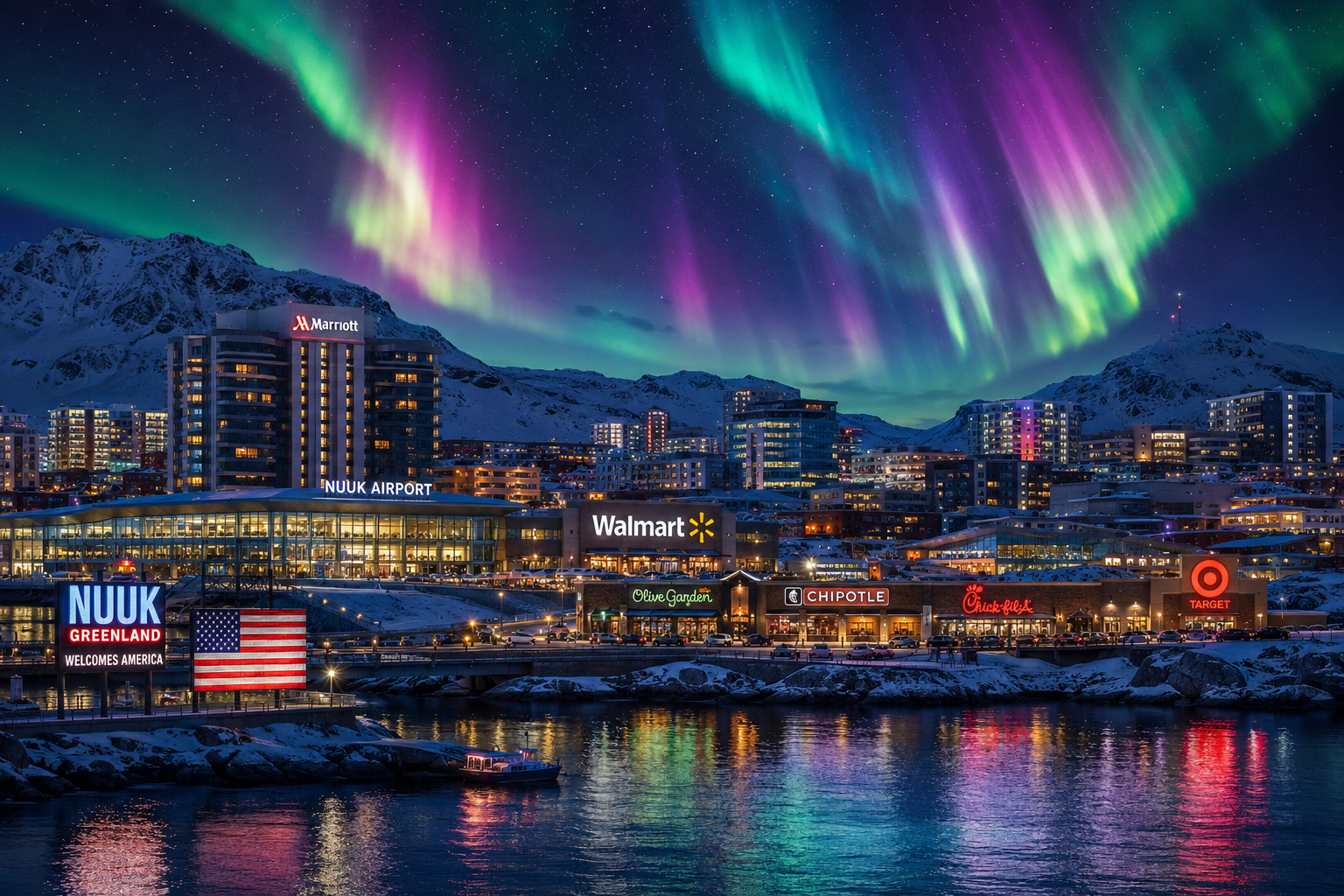
The only things showing up on the shores of Greenland won’t be Marines — it’ll be McDonald’s, Walmart, and a Chick-fil-A. God forbid, maybe even a mini Buc-ee’s. The horror.
And let’s address the elephant in the room about Article 5: the United States IS NATO. For all intents and purposes, the American taxpayer has spent over a trillion dollars underwriting European security so countries like Denmark could spend their defense budgets on bicycle lanes and parental leave. Invoking Article 5 against the country that is Article 5 isn’t a strategy. It’s a cry for others to join their pity party.
The Breakup
Here’s the analogy that actually captures what’s happening.
Denmark is the partner who hasn’t paid much attention to the relationship for 300 years. Greenland was a colony. Then it was “incorporated.” Then it got “home rule.” At every stage, Copenhagen did the absolute minimum to keep up appearances while extracting what it wanted and leaving the island underdeveloped, subsidy-dependent, and frozen — literally in every sense of the word.
Now someone better has shown up. Someone with resources, ambition, and an actual plan. A new suitor who lives right next door. And suddenly Frederiksen is talking about “commitment” and “defending every inch” of Danish territory?
Where was that energy for the last three centuries of their marriage?
Denmark had its chance. It did nothing with the world’s largest island except treat it like a line item on a guilt budget. Sorry. Times have changed. Greenland wants a divorce.
The Real Card Holders
Here’s what every legacy media outlet is getting wrong about this story: they keep framing it as a dispute between the United States and Denmark.
It’s not.
The people holding all the cards are the Greenlanders themselves. All 57,000 of them.
And the offer on their table is staggering: $100,000 per man, woman, and child. Full independence from Denmark. U.S. territorial status. American citizenship. American protection. American investment.
Let’s do the math on what that looks like for a Greenlander currently living on Danish subsidies and a fishing economy:
- $100,000 cash. Per person. For a family of four, that’s $400,000 in an economy where the average income is a fraction of that.
- S. citizenship. Passport. Travel. Legal rights. No more routing through the EU to get anywhere.
- Direct flights to New York, Atlanta, and Orlando. Weekly. Without going through Copenhagen first.
- Real ones. Military base construction. Rare earth mining. Commercial development. Infrastructure that actually gets built.
- S. territorial status — the Puerto Rico model. Cultural autonomy, administrative self-governance, and the full weight of the American economy behind you.
And what does Denmark counter with? Three patrol boats and a speech about solidarity.
That’s not a poker hand. That’s a folded napkin.
The Self-Determination Irony
This is the part that really makes you laugh.
Frederiksen, standing at that podium, actually said: “We hope that all, including all allies, will respect the Greenland people’s right for self-determination.”
Self-determination.
She said the quiet part loud without realizing it. Because self-determination means that Greenlanders themselves get to choose. Not Copenhagen. Not Brussels. Not NATO.
The people who actually live there.
And when the choice is between continued colonial dependency on a European country that’s neglected you for centuries, or independence plus American citizenship plus a six-figure check plus an actual economic future — that’s not a hard vote.
Frederiksen supports self-determination right up until the moment Greenland might actually exercise it. Then suddenly it’s “not for sale” and Article 5 and “defending the kingdom.”
You can’t have it both ways.
Meanwhile, on Facebook…
If you want to know what Denmark is actually feeling underneath the polished podium diplomacy, skip the press conferences. Go to their official Facebook page.
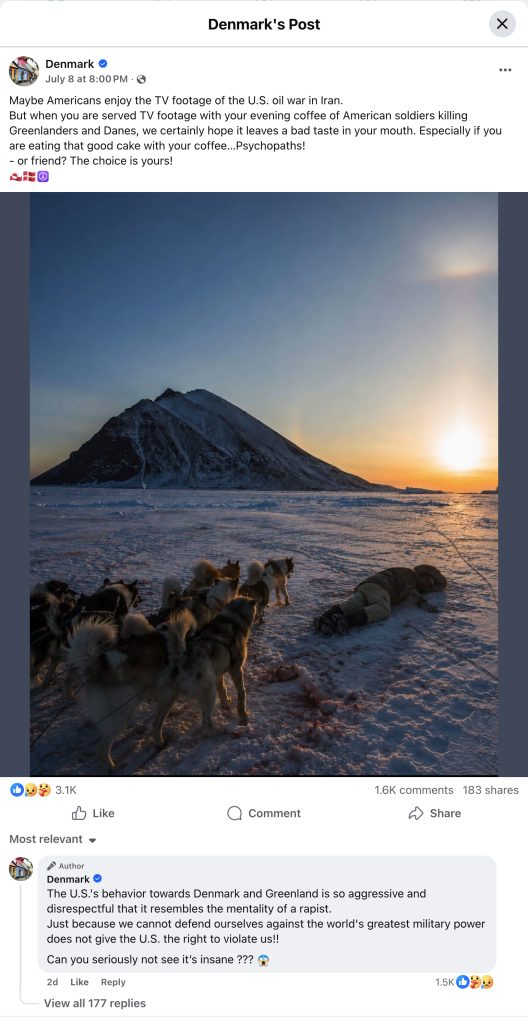
On July 8 — the same day Frederiksen was delivering her composed NATO remarks — Denmark’s verified government Facebook account posted this:
“Maybe Americans enjoy the TV footage of the U.S. oil war in Iran. But when you are served TV footage with your evening coffee of American soldiers killing Greenlanders and Danes, we certainly hope it leaves a bad taste in your mouth. Especially if you are eating that good cake with your coffee…Psychopaths!”
Read that again. A NATO ally’s official government account just fantasized about American soldiers murdering Greenlanders and Danes — and called 330 million Americans “psychopaths” — because someone offered their colony’s residents a better deal.
But it got worse. In the comments, Denmark’s account doubled down:
“The U.S.’s behavior towards Denmark and Greenland is so aggressive and disrespectful that it resembles the mentality of a rapist. Just because we cannot defend ourselves against the world’s greatest military power does not give the U.S. the right to violate us!! Can you seriously not see it’s insane???”
A rapist.
That’s the analogy a Western democracy chose — from a verified government account — to describe a cash offer and a voluntary referendum.
Nobody suggested invading. Nobody threatened violence. The offer on the table is money, citizenship, and a vote. And Denmark’s official response is to conjure images of dead civilians and sexual assault.
This isn’t diplomacy. It’s a tantrum.
And it tells you everything you need to know about the strength of Denmark’s actual position.
When your best argument is a guilt fantasy about American troops killing people who nobody suggested killing, you don’t have an argument. You have panic dressed up as moral outrage.
Frederiksen can stand at the podium and play the composed stateswoman. But her government’s social media team is saying what she won’t: Denmark knows it’s losing, and it has nothing left but emotional manipulation.
The Bet Is Called
Trump put $5.7 billion on the table. Denmark is more than welcome to match the bet. That’s how this works. If you can’t call, you fold.
And here’s the beautiful simplicity of it: there won’t be an invasion. There won’t be a military confrontation. There won’t be a NATO crisis. There will be a vote. A free, democratic, self-determined vote by the people of Greenland.
And Denmark won’t be running it.
The island’s 57,000 residents — probably fewer people than the number of illegal immigrants Biden let into D.C. alone, but let’s not digress — will decide their own future. And when the ballot asks whether they’d like American citizenship, American investment, American protection, and a hundred thousand dollars, or whether they’d like to keep waiting for Copenhagen to remember they exist…
Well. That’s not really a vote, is it?
It’s a formality.