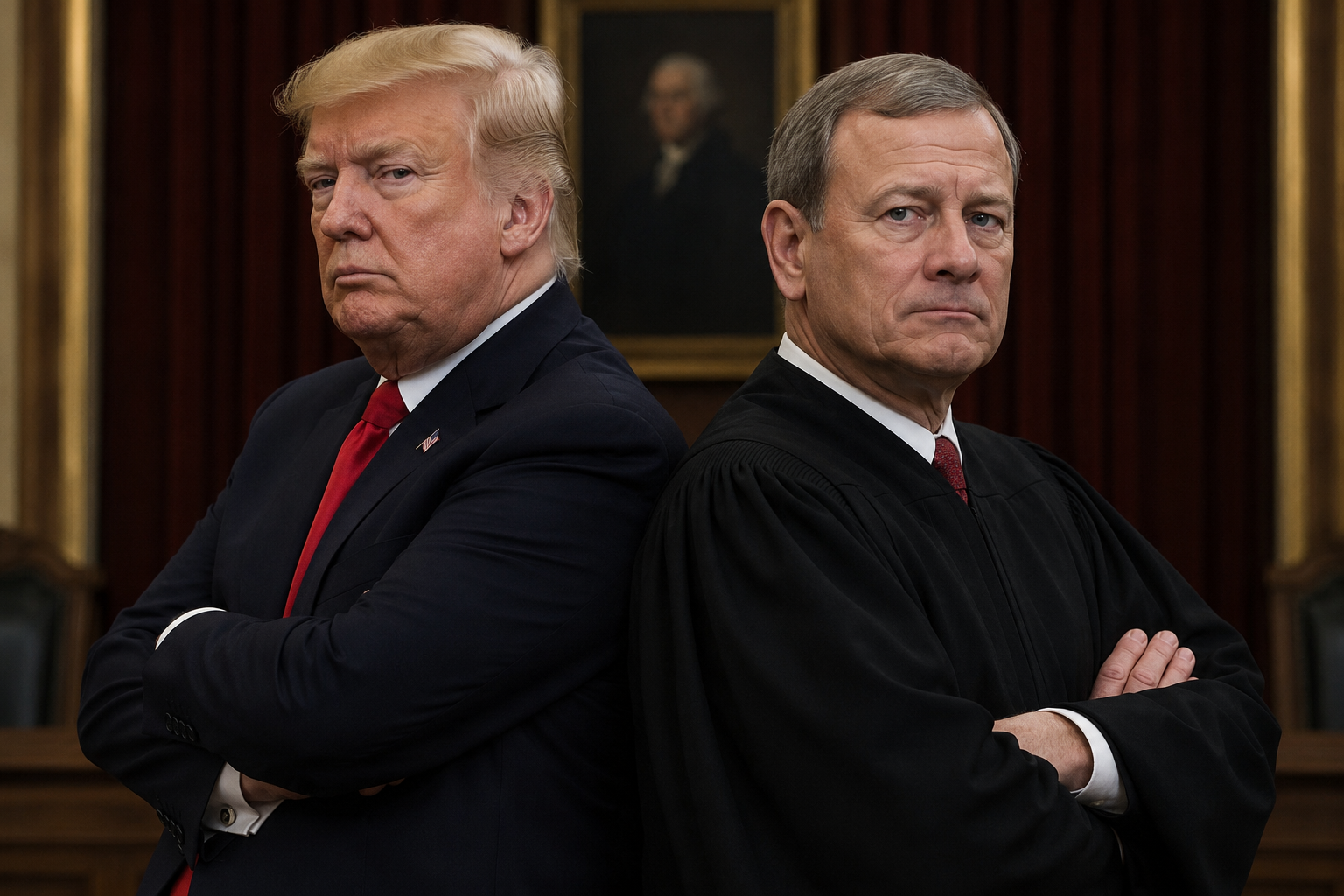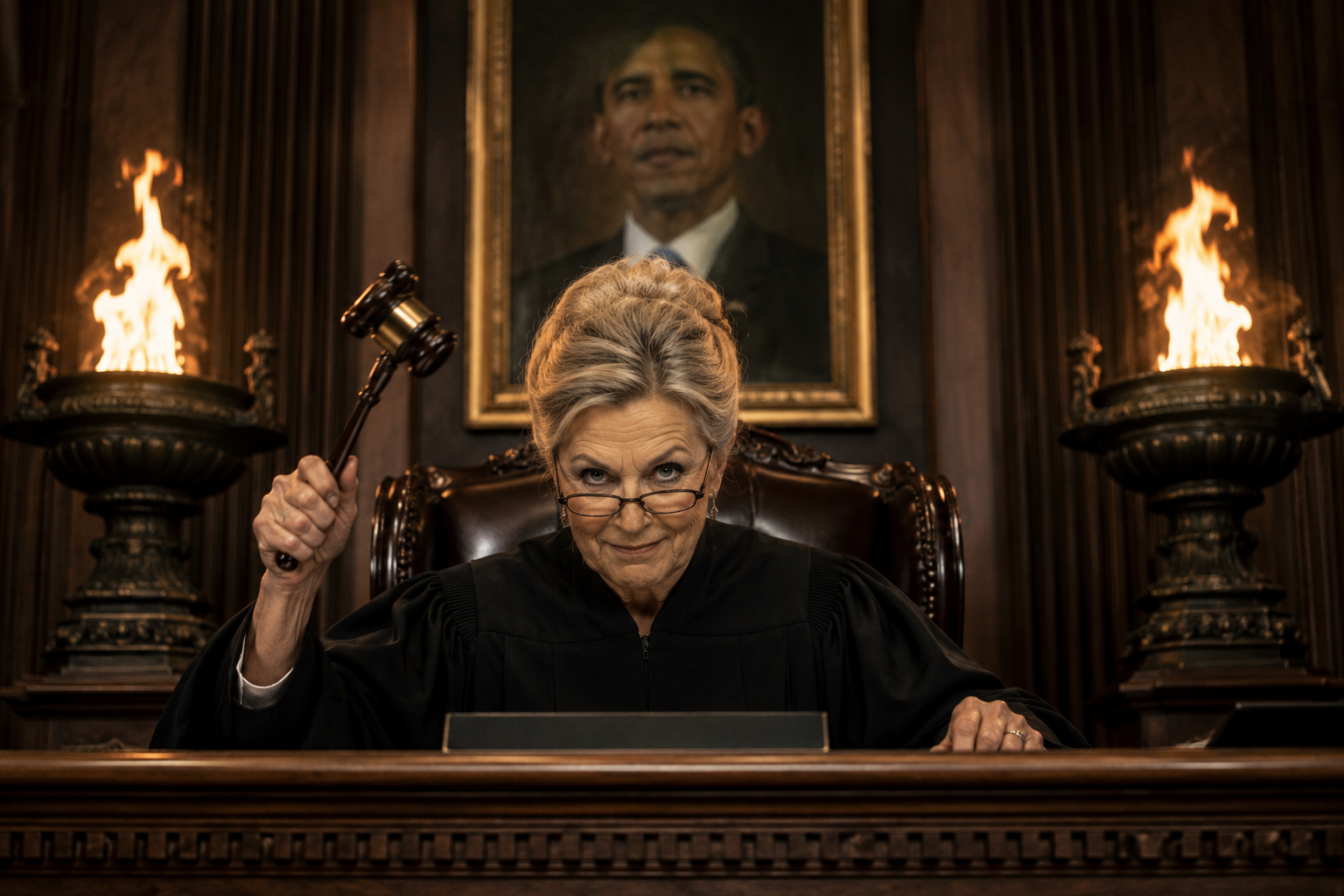
In 2010, Denise Casper sat before the Senate Judiciary Committee as an Obama appointee and told the senators exactly what they wanted to hear. She would “objectively and neutrally apply the law to the facts as found.” She rejected the “living Constitution” approach. She pledged “strict adherence to Supreme Court and circuit precedent.” She said empathy has no place in interpreting the law.
Sixteen years later, she wrote 59 pages proving she didn’t mean a word of it.
Last week, Chief Judge Casper — an Obama appointee now running the District of Massachusetts — attempted to “permanently strike down” President Trump’s executive order on election integrity. Trump’s executive order simply directed the Election Assistance Commission to require documentary proof of citizenship on federal voter registration forms, imposed an Election Day receipt deadline for mail-in ballots, and threatened to withhold federal funding from states that refused to comply.
Casper declared the entire order unconstitutional. Her reasoning? The president has no authority over elections. Separation of powers. States and Congress run elections, not the executive branch.
It sounds tidy. Constitutional, even. Until you check the receipts.
Here’s a rule of thumb that saves you from reading a lot of bad judicial opinions: if a ruling is longer than twenty pages, the judge is probably building a legal theory instead of applying statutes and precedent already on the books.
A straightforward application of existing law doesn’t need 59 pages.
Brown v. Board of Education was 11. Miranda v. Arizona was 58, and it created an entirely new constitutional doctrine from scratch.
When a district court judge needs 59 pages to explain why the president can’t direct a federal agency to do something the Supreme Court already said that agency can do — the length is the tell. She’s not applying law. She’s constructing a framework to reach a conclusion the existing statute and/or precedent doesn’t support.
And what precedent is she attempting to ignore?
Arizona v. Inter Tribal Council of Arizona. 2013. Justice Antonin Scalia writing for the majority.
In that case, the Supreme Court explicitly addressed whether the Election Assistance Commission has the authority to require documentary proof of citizenship on the federal voter registration form.
Scalia’s opinion confirmed that the EAC possesses discretionary authority under the National Voter Registration Act to modify the federal form — including adding proof-of-citizenship requirements — when a state demonstrates that existing attestation requirements are insufficient to enforce its voter qualifications.
Read that again.
The Supreme Court already decided this. The EAC can require proof of citizenship. Scalia wrote the opinion.
It’s settled law.
So what did Trump’s executive order actually do? It directed the EAC — an executive branch agency created by Congress under the Help America Vote Act of 2002 — to exercise authority the Supreme Court already confirmed it possesses.
That’s not the president legislating. That’s the president doing exactly what Article II says he’s supposed to do: taking care that the laws be faithfully executed.
Casper’s entire “separation of powers argument” collapses the moment you acknowledge what the EAC actually is. It’s not an independent regulatory body like the Federal Reserve.
It’s an executive agency.
The president directing an executive agency to use its congressionally delegated authority isn’t a separation of powers violation — it’s a textbook exercise of the unitary executive doctrine that the Supreme Court has reaffirmed repeatedly in Seila Law v. CFPB and Collins v. Yellen.
But you won’t find that analysis anywhere in Casper’s 59 pages.
Arizona v. Inter Tribal Council is conspicuously absent from the framework she constructs. She doesn’t distinguish it. She doesn’t argue it’s inapplicable. She simply builds her entire ruling as though it doesn’t exist.
That’s not judging. That’s legislating from the bench with a black robe.
And Casper knows it won’t survive appeal. She has to know. She cannot be that stupid.
The First Circuit will review this, and when they do, they’ll have to contend with the Scalia opinion she pretended wasn’t there.
If it reaches the Supreme Court — and given the administration’s track record of pushing election cases upward, it likely will — the same Court that decided Arizona v. Inter Tribal Council will be asked whether a district judge can simply ignore their prior ruling because it produces the wrong political outcome.
That’s not a question with a complicated answer.
So why did she do it? Why did Casper IGNORE settled law?
Because the goal was never to win on the law. The goal was to run out the clock.
The 2026 midterms are five months away. Ballots start going out in some states in August. A 59-page “permanent” injunction — which Fox News dutifully reported as though the word “permanent” means what it sounds like — creates enough procedural delay to prevent the proof-of-citizenship requirement from being implemented before November.
By the time the appellate courts unwind what Casper did, the election will be over.
The ruling isn’t a legal document. It’s a stall tactic dressed up in constitutional language.
And it’s not even an original one. Casper is running the same playbook that Obama and Biden appointees have been running against this administration since January 2025. Issue a sweeping injunction from a friendly district court. Write enough pages to make it look scholarly. Force the DOJ to burn weeks on an appeal. Repeat.
Casper’s “permanent” injunction also reads more like a press release than a judicial opinion. Buried inside the 59 pages, she editorially declared that “there is no evidence in this record of widespread ‘illegal voting, discrimination, fraud, and other forms of malfeasance and error’ within American elections.” That’s not a legal finding. That’s a political statement. A judge’s job is to evaluate the constitutionality of the executive order — not to render a verdict on the national debate over election fraud.
She went further, writing that mail ballot restrictions “would disproportionately harm military voters, elderly voters, voters with disabilities and voters in rural areas.” That’s policy advocacy. That’s something you’d hear from a Democratic strategist on CNN, not from a federal judge applying constitutional law. When your judicial opinion starts making political arguments about who gets “harmed” by election security measures, you’ve stopped being a judge and started being an activist.
She’s not alone. A federal judge in California opened a related voter-roll opinion with a Benjamin Franklin quote about “A Republic, if you can keep it,” declared that “history demonstrates that democracy can be lost in a generation,” and wrote that “it seems the Executive Branch of the United States government wants to abridge the right of many Americans to cast their ballots.” That’s not a judicial opinion. That’s a term paper with a gavel.
And don’t think the Supreme Court hasn’t noticed these shenanigans.
In Trump v. CASA last June, the Court ruled 6–3 that district courts generally lack the authority to issue nationwide injunctions altogether. Justice Barrett wrote that such injunctions “likely exceed the equitable authority that Congress has granted to federal courts.”
Since January 2025, the Court has overturned at least 17 lower court rulings blocking Trump administration actions.
Seventeen.
Casper’s ruling will almost certainly be number eighteen.
But by then, its real job will already be done.
That’s the game. And until you understand that the purpose of these rulings isn’t to establish law but to delay its implementation, you’ll keep being surprised when a federal judge writes 59 pages of constitutional analysis that ignores the single most relevant Supreme Court precedent on the question.
She told the Senate she’d follow precedent. The precedent was inconvenient. So she wrote 59 pages around it.
THE PATTERN: District Court Rulings Overturned
- Trump v. CASA (June 2025): SCOTUS ruled 6–3 that three district courts exceeded their authority by issuing nationwide injunctions against the birthright citizenship EO. Barrett wrote that universal injunctions “likely exceed the equitable authority” of federal courts.
- Judge Jia Cobb (Biden, D.C.): Blocked nationwide expedited removal. Reversed by the D.C. Circuit in June 2026. Court found the policy was lawful and the lower court applied the wrong standard.
- Judge Brian Murphy (Biden, D. Md.): Issued repeated nationwide immigration injunctions. Reversed 7–2 by the Supreme Court.
- Judge Randolph Moss (Obama, D.D.C.): Blocked Trump deportation appeal reforms. Previously reversed by the D.C. Circuit on a federal execution scheduling ruling.
- Judge P. Casey Pitts (Biden, N.D. Cal.): Issued a 71-page nationwide injunction blocking ICE courthouse arrests. Currently on appeal.
- Judge Indira Talwani (Obama, D. Mass.): Blocked Trump’s second election EO on USPS ballot authority in a 37-page ruling. Issued the same week as Casper’s ruling. Currently on appeal.
- NBC News reported in 2025 that the Supreme Court overturned at least 17 lower court rulings blocking Trump administration actions, with five containing no substantive reasoning and seven containing fewer than three pages of explanation.